

Fluorescent gummy bears provided a dazzling introduction: during a visit to a Year 3 class at the Evangelical Primary School in Burg, Michael Lippert explained how dyes and fluorescence work. What might otherwise have sounded like laboratory jargon became immediately apparent: some substances glow when stimulated in a particular way.
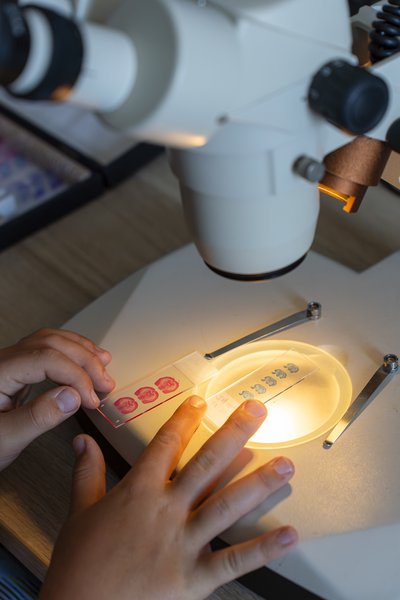
Next, the children took a very close look at the brain. Working alongside Magdalena Sauvage’s research group on the functional architecture of memory, the children stained brain sections and examined them under various microscopes. This enabled them to visualise brain cells and observe structures that are invisible to the naked eye. Smell and touch also played a part. Through small behavioural tests involving tasks related to smell and touch, the children explored how perception works and how closely it is linked to memory. By smelling, feeling and comparing, they gained an initial insight into scientific work.
The scientific focus of the visit was the hippocampus. This small region of the brain helps us to store and later recall experiences. The research team explained why the hippocampus is important for learning and memory, and the consequences of impairment. This also emphasised the relevance of memory research in relation to conditions such as Alzheimer's and dementia, as well as the consequences of accidents and traumatic experiences. The children also learnt about the methods researchers use to visualise cells, measure activity, and examine the brain.
Ultimately, the visit offered more than just a glimpse through a microscope or a glowing gummy bear. The visit demonstrated that research can not only satisfy curiosity, but also stimulate it, particularly when children are encouraged to ask questions, observe and conduct their own experiments.