

How the Brain Remains Flexible and Stable During Learning
Researchers at the LIN have shown that learning alters inhibitory connections at different locations on the same neuron in opposite ways.
Our brain must be able to learn new things without losing the stability of its networks. Researchers at the Leibniz Institute for Neurobiology (LIN), together with partners from Bielefeld and Zurich, have investigated how this might be achieved. Their findings show that inhibitory connections in the brain change differently during learning depending on their location on a neuron.
The study focuses on so-called inhibitory synapses. These contact points between neurons regulate how information is processed and transmitted. The researchers examined them in the hippocampus of mice, a brain region that plays a key role in learning and memory.
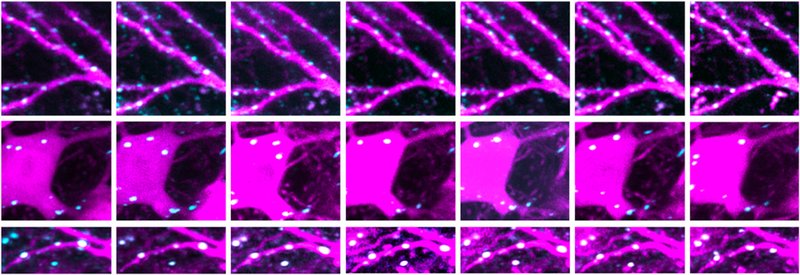
In the process, they discovered a remarkable difference: at the branched extensions through which neurons receive information, inhibitory synapses are reorganized more frequently after learning. At the axon head, however—where the neuron generates its own electrical signals—they become more stable.
“It is surprising that inhibitory synapses within the same neuron do not respond uniformly to learning,” explains Alessio Attardo of the LIN.
For the study, the research team observed more than 1,100 inhibitory synapses in the brains of 23 mice over a period of 13 days. The results provide new insights into how neural networks might facilitate changes during learning while remaining stable.
The study was conducted in close collaboration between the research groups of Alessio Attardo and Stefan Remy at the LIN and partners at the Universities of Bielefeld and Zurich. It was published in the journal Nature Communications.
Further Information